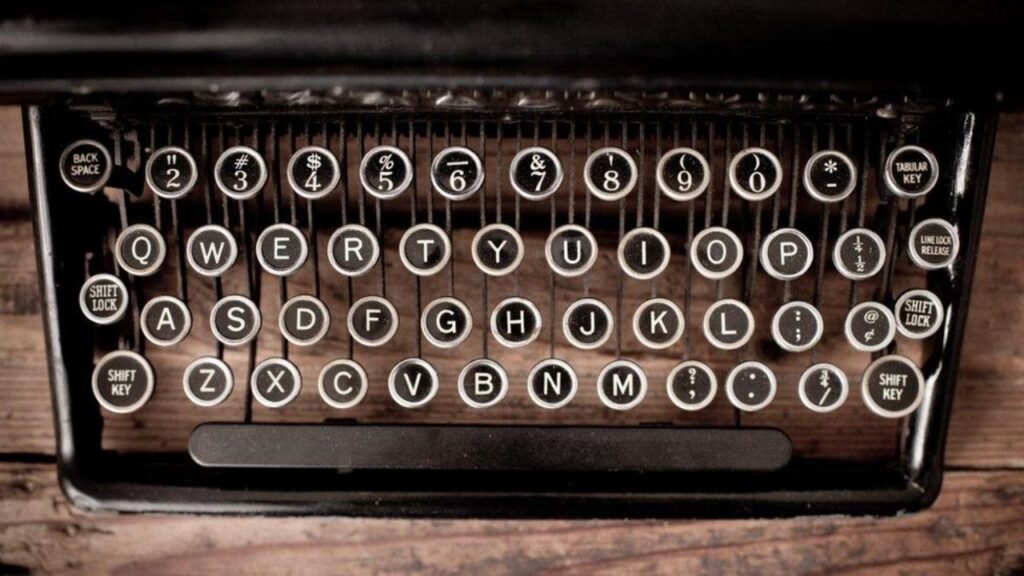
The QWERTY keyboard is something most people use every day without thinking twice. Whether typing on a laptop, desktop, or even a smartphone, the familiar arrangement of letters has become a global standard. But QWERTY was not designed for speed or comfort in the modern sense. Its origins are deeply rooted in the mechanical limitations of early typewriters, and its survival is a story shaped by history, habit, and technology.
The Birth of the QWERTY Layout
The QWERTY keyboard was developed in the early 1870s by Christopher Latham Sholes, an American inventor working on one of the first practical typewriters. Early typing machines used mechanical arms, called typebars, that struck ink onto paper. These typebars were prone to jamming if neighboring keys were pressed too quickly in succession.
To solve this problem, Sholes rearranged commonly used letter combinations so they were physically farther apart on the machine. This reduced the chance of jams and allowed typists to work more smoothly, even if it slightly slowed typing speed. The first six letters on the top row spelled “QWERTY,” giving the layout its name.
How QWERTY Became the Standard
In 1873, the Remington company began manufacturing typewriters using the QWERTY layout. Remington was already well-known for producing sewing machines and firearms, which helped give credibility to its typewriters. As more offices adopted Remington machines, QWERTY became increasingly common.
Training also played a major role. Typing schools taught QWERTY, businesses hired workers trained on QWERTY machines, and switching layouts became impractical. Once people invested time learning the system, there was little incentive to change, even when better layouts appeared later.
Was QWERTY Designed to Slow Typing?
A common myth is that QWERTY was intentionally designed to slow typists down. While it is true that it was meant to prevent mechanical jams, it was not created to reduce productivity. At the time, QWERTY was actually an improvement over earlier alphabetical layouts, which caused frequent jams and frustration.
The goal was balance, not limitation. Sholes aimed to make typing reliable and consistent, even if it meant spacing out commonly used letters.
Alternative Keyboard Layouts
Over the years, several alternative layouts have been proposed. One of the most famous is the Dvorak Simplified Keyboard, introduced in the 1930s. Dvorak was designed to reduce finger movement, place common letters on the home row, and improve typing efficiency.
Despite studies suggesting potential benefits, Dvorak and other layouts never replaced QWERTY. The reasons include retraining costs, resistance to change, and the fact that modern software and hardware are already optimized for QWERTY users.
QWERTY in the Digital Age
Modern computers no longer have the mechanical limitations that originally shaped QWERTY. Keys do not jam, and typing speed is influenced more by muscle memory than layout design. Yet QWERTY remains dominant across desktops, laptops, tablets, and smartphones.
This persistence highlights a broader truth about technology: once a system becomes widely adopted, familiarity often outweighs efficiency. Billions of people have learned QWERTY, making it one of the most successful interface designs in history.
Why QWERTY Still Matters Today
The QWERTY keyboard is a powerful example of how early design decisions can shape future technology. It reminds us that standards are not always chosen because they are perfect, but because they work well enough and gain widespread acceptance.
Even as voice typing and touch interfaces grow more advanced, the QWERTY keyboard continues to serve as a primary tool for written communication worldwide.
Conclusion
The QWERTY keyboard was born from necessity, shaped by mechanical constraints, and preserved through habit and global adoption. While alternatives exist, QWERTY’s legacy endures because of its history, familiarity, and deep integration into modern technology. Every time we type, we are using a system designed over a century ago, still influencing how humans communicate today.