Time feels universal, but the way humans measure it has changed dramatically over history. Today, we live by clearly defined time zones, yet this system is relatively modern. For most of human history, people did not need standardized time at all. The introduction of time zones was driven by technology, transportation, and the need for coordination in an increasingly connected world.
Life Before Time Zones
Before the nineteenth century, time was local. Each town or city followed its own “solar time,” based on the position of the sun in the sky. Noon was simply when the sun was at its highest point. This system worked well when travel was slow and communication over long distances was rare.
However, local solar time created problems as societies expanded. Two neighboring cities could have clocks that differed by several minutes, and larger distances resulted in even greater differences. As long as people rarely traveled far, this inconsistency was manageable.
The Problem Created by Railways
The need for standardized time became urgent with the rise of railways in the nineteenth century. Trains could travel faster than ever before, connecting cities across vast distances. Railway companies needed reliable schedules to prevent accidents and manage departures and arrivals.
Without a common time system, coordinating train movements was difficult and dangerous. Different local times made printed timetables confusing, and even small discrepancies could lead to collisions on shared tracks. Railways were among the first to adopt standardized time, often setting clocks according to a major city.
The Birth of Time Zones
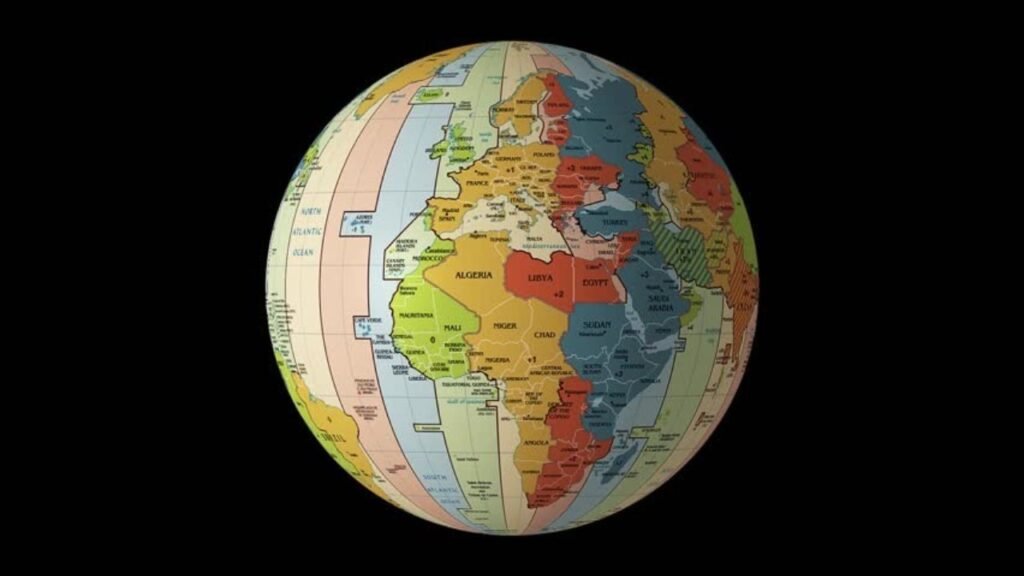
The idea of dividing the world into time zones is commonly credited to Sir Sandford Fleming, a Canadian engineer. He proposed a global system based on Earth’s rotation, dividing the planet into 24 zones, each roughly 15 degrees of longitude wide. Since Earth rotates once every 24 hours, each zone would differ by one hour.
In 1884, the International Meridian Conference was held in Washington, D.C. Representatives from multiple countries agreed to establish the Prime Meridian at Greenwich, England. This created the reference point now known as Greenwich Mean Time, which later evolved into Coordinated Universal Time.
Gradually, countries adopted time zones based on this system, though not always strictly following the 15-degree rule.
How Time Zones Work Today
Modern time zones are still based on Earth’s rotation, but political and practical considerations often shape their boundaries. Instead of perfectly straight vertical lines, time zones frequently bend to match national borders, population centers, or economic needs.
Most countries operate on a single time zone for simplicity, even if their geography spans a wide area. Others use multiple zones to better align daylight hours with daily life. Some regions also adopt offsets of 30 or 45 minutes rather than full hours, creating additional variation.
Coordinated Universal Time serves as the global reference standard. All time zones are defined by their offset from it, such as UTC+5 or UTC−8.
Daylight Saving Time
In addition to time zones, many regions observe Daylight Saving Time. This practice involves adjusting clocks forward during part of the year to extend evening daylight. The idea was originally promoted to conserve energy and make better use of natural light.
Daylight Saving Time is not universally adopted. Some countries use it seasonally, others have abolished it, and many never implemented it at all. This adds another layer of complexity to global timekeeping.
Why Time Zones Still Matter
Time zones play a critical role in modern life. They enable international travel, global business, communication, and digital systems to function smoothly. Everything from airline schedules to online meetings depends on accurate time coordination.
Despite occasional debates about reform or simplification, time zones remain essential. They reflect both the natural movement of Earth and the social structures humans have built around time.
A System Shaped by Progress
Time zones were not created for convenience alone. They emerged as a solution to real problems caused by technological progress. While imperfect and sometimes confusing, they continue to help billions of people stay synchronized in a world that never stops moving.
Understanding how time zones came to exist offers insight into how human systems evolve in response to change.