
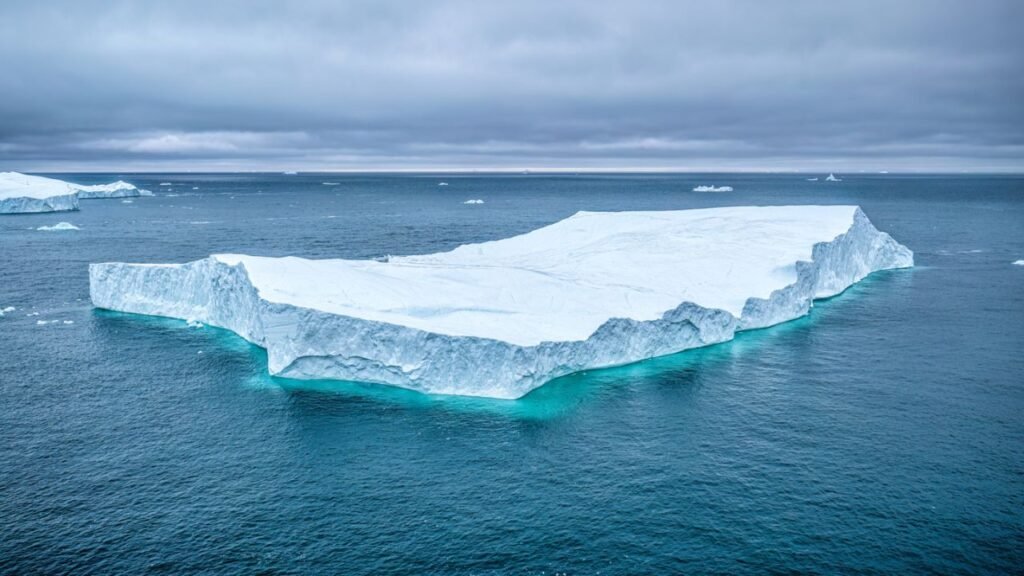
At first glance, ice floating on water may seem like an ordinary sight. A glass of ice cubes, a frozen lake, or snow resting on the surface of water rarely makes us stop and think. However, this simple phenomenon is one of the most important reasons life exists on Earth. Unlike most substances, water behaves in an unusual way when it freezes, and that unique behavior has shaped ecosystems, climate patterns, and the survival of countless species.
Understanding why ice floats requires a closer look at how water molecules behave and why their structure changes when temperatures drop.
The Unique Structure of Water Molecules
Water is made up of two hydrogen atoms bonded to one oxygen atom. This simple structure gives water a property called hydrogen bonding. These bonds cause water molecules to attract each other in a specific arrangement.
When water is in liquid form, its molecules move freely, sliding past one another while remaining closely packed. As water cools and approaches freezing, the molecules begin to slow down and organize themselves into a rigid, crystal-like structure. This structure takes up more space than liquid water, even though the number of molecules remains the same.
As a result, ice becomes less dense than liquid water. Density refers to how much mass is packed into a given volume. Since ice occupies more space with the same mass, it is lighter than the water beneath it, allowing it to float.
Why Most Substances Sink When Frozen
For most materials, freezing causes molecules to pack more tightly together, making the solid form denser than the liquid. This is why frozen metal, rock, or wax typically sinks in its melted form.
Water is one of the rare exceptions. Its hydrogen bonds force molecules into an open, hexagonal structure when frozen, creating empty spaces within the ice. These spaces reduce overall density, setting water apart from most other liquids on Earth.
How Floating Ice Protects Aquatic Life
The fact that ice floats has enormous implications for life, especially in cold environments. When lakes, rivers, or oceans freeze, the ice forms on the surface rather than sinking to the bottom. This creates a protective layer that insulates the water below.
Underneath the ice, liquid water remains at a stable temperature that allows fish, plants, and microorganisms to survive through winter. If ice were to sink instead, bodies of water would freeze from the bottom up, potentially freezing solid and killing nearly all aquatic life each winter.
This natural insulation helps ecosystems recover each spring and maintains biodiversity in cold and temperate regions.
The Role of Ice in Earth’s Climate
Floating ice also plays a key role in regulating Earth’s climate. Ice reflects sunlight back into space, a process known as the albedo effect. Large ice-covered areas, such as polar ice caps and frozen lakes, help keep the planet cooler by reducing the amount of heat absorbed by the Earth’s surface.
If ice sank instead of floating, this reflective layer would be lost, leading to warmer water temperatures and accelerated climate changes. The balance between ice formation and melting is closely tied to global temperature patterns and weather systems.
Ice and the Origin of Life
Scientists believe that Earth’s early oceans benefited greatly from floating ice. During periods when the planet was much colder, surface ice likely shielded the water below from extreme temperatures and harmful radiation. This stable environment may have allowed early life forms to develop and evolve.
Without floating ice, these early aquatic environments might have frozen entirely, making the emergence of life far less likely.
Why This Simple Phenomenon Matters Today
The floating nature of ice continues to support life every day. From preserving freshwater ecosystems to stabilizing global climate systems, this small physical property has enormous consequences. It reminds us that even the most familiar natural processes can have deep and far-reaching impacts.
Ice floating on water is not just a scientific curiosity. It is a foundational reason why Earth remains a living planet.
Final Thoughts
The next time you see ice floating in a drink or covering a frozen lake, remember that this simple phenomenon is one of nature’s most important safeguards. Without it, life on Earth as we know it might never have existed.